Refuel today or wait? How the price trend works
To help you decide whether to fill up today or wait a few days, GasHoy tracks how official average fuel prices in Spain are moving and clearly indicates whether the current trend is rising, falling, or holding steady.
Last updated: 11/11/2026
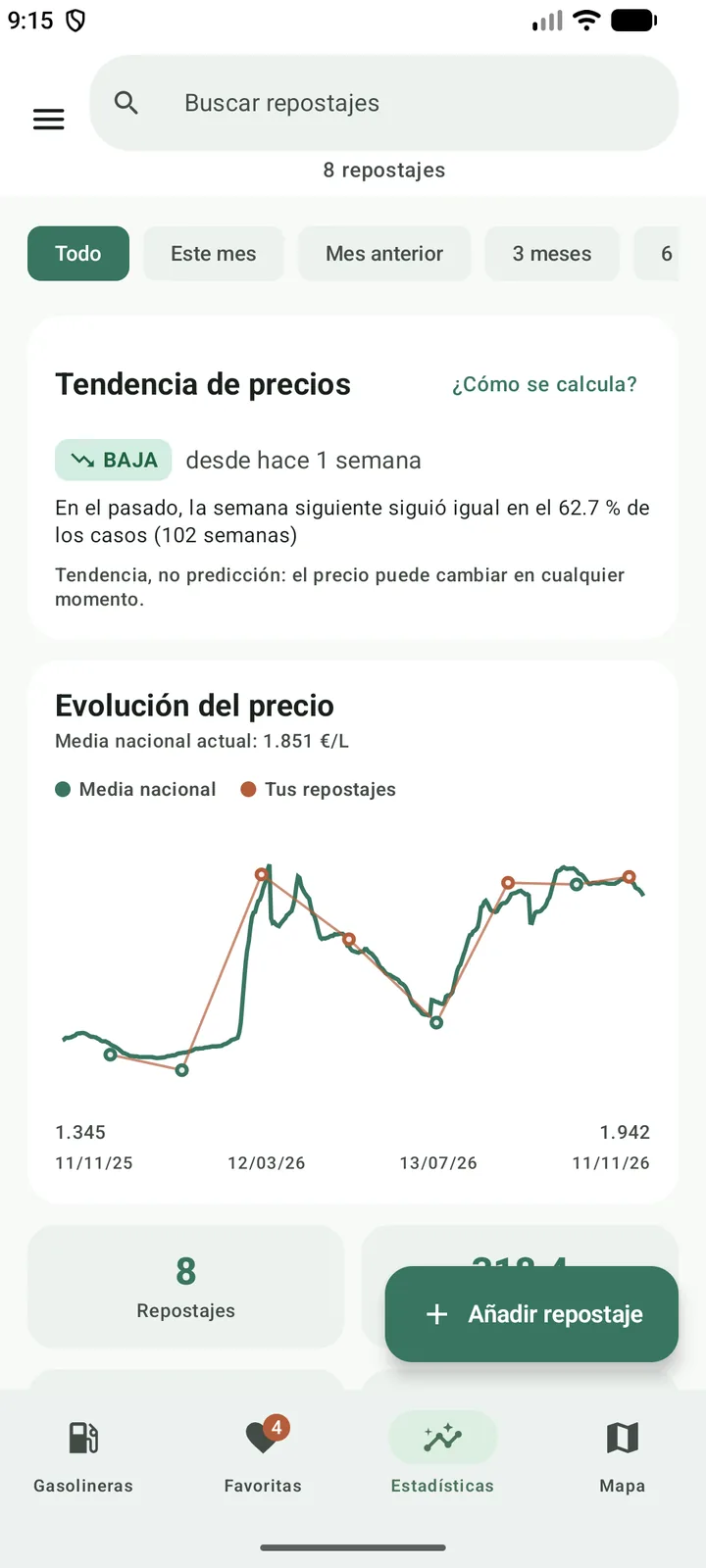
What the trend card tells you (RISING, FALLING, HOLDING STEADY)
Inside GasHoy's statistics tab you will find a dedicated card for each official fuel (Petrol 95, Diesel, Petrol 98, Diesel+, Gasoil B, LPG, and CNG). This card summarises overall market movement in three states:
The past 7-day average exceeds the previous 7-day average by more than half a cent per litre.
The recent average is more than half a cent per litre lower than the preceding 7 days.
The change stays within the half-cent margin: prices are holding steady.
How the trend is calculated step by step
The calculation relies on neither guesswork nor opaque formulas. It uses a straightforward mathematical comparison of 7-day rolling averages:
- Calculation scope: it is calculated on the daily national average across Spain for each fuel type, not on individual petrol stations.
- Comparing two 7-day blocks: the average of the past 7 days is compared against the average of the 7 days immediately before them.
- ±0.005 €/L tolerance band: if the absolute change does not exceed 0.005 €/L (half a cent), the app labels the situation as "holding steady".
Worked calculation example:
Suppose, as a hypothetical example, that Spain's national average for Petrol 95 over the past 7 days is 1.512 €/L and the average for the previous 7 days was 1.500 €/L. Subtracting gives a difference of +0.012 €/L. Since +0.012 €/L is greater than +0.005 €/L, the indicator shows RISING.
If in another period the recent average were 1.502 €/L compared with the same 1.500 €/L beforehand, the +0.002 €/L difference would fall inside the ±0.005 €/L band and display HOLDING STEADY.
Transparency: how often the trend holds true
To avoid any impression of empty promises, the app openly shows the indicator's historical hit rate alongside the total number of weeks analysed.
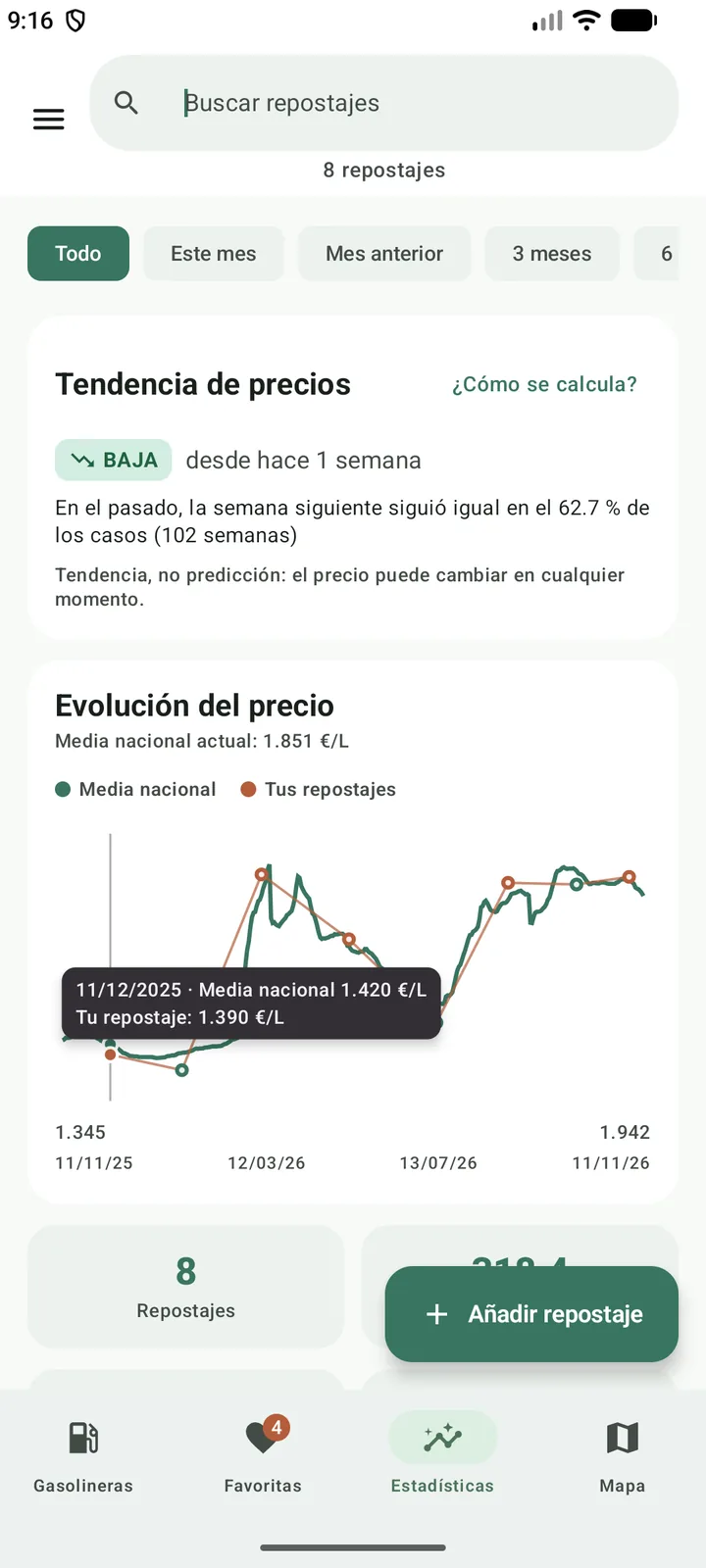
Accuracy literally means: "the following week moved in the same direction as the previous week in that percentage of cases". As of 11/11/2026 (covering 20/11/2024 to 10/11/2026), the figures shown in the app were:
Note: these percentages update weekly as historical data grows. If a fuel has fewer than 20 weeks of data, the app does not display a percentage until that threshold is reached.
What GasHoy's trend is not
Not a guaranteed forecast or predictive model: GasHoy does not use AI models to guess the future or promise that prices will drop. It strictly reflects the mathematical momentum of past official data.
Not buying or financial advice: when to fill your tank is always your own decision.
Each station sets its own prices: even if the national average falls, a specific station near you may still choose to keep or raise its pump prices.
How to use this information before refuelling
The trend is most useful when you still have enough fuel left for several days of driving:
- •If it shows FALLING: if you do not need to refuel urgently, waiting a couple of days may let you take advantage of lower prices along your route.
- •If it shows RISING: if your tank is getting low, filling up today helps you avoid the average price increase that often reaches pumps over the following days.
- •If it shows HOLDING STEADY: refuel whenever suits you best and simply pick the cheapest station within your chosen radius.
Frequently asked questions about the trend
Does the trend predict the price at my local petrol station?
No. The calculation uses the daily national average for each fuel across Spain and relies strictly on past data. It is neither a prediction nor a price guarantee: every service station sets its own pump prices freely.
Why is a ±0.005 €/L fluctuation band used?
The ±0.005 €/L band filters out minor market noise so periods without a clear upward or downward move are shown as "HOLDING STEADY".
How often is the trend indicator updated?
The indicator updates daily as soon as the latest official figures published by Spain's Ministry for the Ecological Transition and the Demographic Challenge (MITECO) are synced.
What happens if a fuel has less than 20 weeks of history?
The app requires at least 20 continuous weeks of data before showing an accuracy percentage. Below that threshold, the figure is not displayed.
GasHoy is free for Android 7.0 or higher, with no sign-up and official MITECO data.